

MOVING TO A NEW OFFICE? PLANNING A BUILD-OUT?
Commercial Network Cabling For Your Office Move & Build-Out
Your next office starts with an empty space—and decisions about office network cabling, Wi-Fi, and conference room connections. Charlotte Data Solutions walks the space with you, plans the infrastructure around your needs, and coordinates the installation with your IT provider, general contractor, and other trades.
25+ years in IT & structured cabling · 9 years coordinating commercial construction projects.
Office Network Cabling & Technology Setup for Your New Office
Your IT team knows what your business needs. Your general contractor knows how to build the space. We understand both—and help connect those requirements before important details get missed.
We help identify connection needs, cable pathways, Wi-Fi locations, and network room requirements early. Then we coordinate our installation with your project team, helping catch missing details before walls and ceilings are finished.
Walk The Space With You
Review the existing infrastructure and discuss how you’ll use each part of your new office.
Plan Around Your Business
Plan connections for workstations, Wi-Fi, conference rooms, and network equipment, with room for growth.
Coordinate With Your Team
Work alongside your IT provider, general contractor, electrician, and building management throughout the installation.
We Install The Office Network Cabling For Your New Office
Your office layout determines where connections need to go. We plan and install the cabling and infrastructure for the people, equipment, and meeting spaces throughout your new office.
Our goal is to set your network up for success while you focus on your business.
Why Hire a Structured Cabling Specialist?
Your network connects the people, equipment, and systems your business depends on. Getting it right takes more than running your office network cable from one location to another. Structured cabling is a specialized trade.
Can't We Just Use The Electrician to Run Data Cables?
An electrical contractor can include network wiring in a build-out, and some have dedicated structured cabling teams. The important question is who is planning, installing, and testing your network infrastructure—and whether that is their specialty.
We’re often called after a business moves into a newly finished office and discovers connections in the wrong places, unreliable network performance, or Wi-Fi that doesn’t cover the space properly. Correcting those problems after move-in can mean opening finished surfaces, interrupting employees, and paying for work a second time.
How We Are Different.
Charlotte Data Solutions brings IT knowledge and construction coordination experience to your project from the beginning. We understand what your IT team needs and how to coordinate cable routes, connection locations, access points, and network rooms with the build-out. Our combined IT and construction experience helps us anticipate issues that could affect your network installation and address them before they become costly changes.
Read our article on why some new network installations fail on day one.
What We Consider Before The Cable Goes In The Wall
We work alongside your electrician and general contractor to deliver structured cabling that’s carefully planned, professionally installed, and built around your business.
Avoid Delays and Costly Mistakes
The company you hire to build your Office Network Cabling. Don’t wait until construction is underway to discover that data cabling isn’t included in your electrical contractor’s scope—or that no one has planned who will install it.
Missing cable pathways, connections in the wrong locations, and unclear responsibilities can delay your office build-out. Discovering those issues after walls and ceilings are finished can mean reopening surfaces and paying for work twice.
We review your plans with your IT provider and construction team early, confirm the scope and connection requirements, and coordinate installation around the construction schedule—so your network infrastructure is part of the plan from the beginning.
What should you budget for network cabling for your Office Build Out?
When you’re looking for a new office, monthly rent is only part of the picture. Construction, furniture, moving costs, and network infrastructure all belong in your early budget—even when they aren’t obvious in the lease.
Existing network cabling doesn't always need replacing during an office move. It is possible to use the current wiring, which could save you thousands on your move. However, aging infrastructure, poor installation practices, and changing network requirements can create hidden problems. Learn more about the risks of aging network infrastructure and why evaluating existing systems before making changes matters.
As a starting point, LoopNet’s office build-out cost guide suggests budgeting $2–$3 per square foot for voice and data wiring. That is a useful number to use for your early budgeting purposes.
For example, a 5,000-square-foot office with 20 private offices, a conference room, a reception area, and a kitchen, $10,000–$15,000 is a useful number to put on your whiteboard for network wiring as you begin planning. Of course, Your budget for computers, software needs, network switches, wireless access points, and other IT hardware would be in addition to that amount. This would be a good starting budget guideline.
When you’re ready to explore a space more closely, Charlotte Data Solutions can walk through it with you, discuss how you plan to use it, and provide a detailed quote based on your needs.
Planning an office build-out?
Let’s talk about your data cabling and networking project.
Who We Work With For Office Moves & Build-Outs
We work directly with businesses planning their next office move, as well as the property teams and contractors preparing the space. Whether you hire us directly or bring us into an existing project team, we coordinate the network infrastructure around your business needs and build-out plans.
Our Network Cabling Process for Office Moves & Build-Outs
Primary Service Areas: Charlotte Metro & Hickory–Unifour
Serving businesses throughout the Charlotte Metro and Hickory–Unifour regions, with expanded coverage available across Western and Central North Carolina and Upstate South Carolina for larger projects.
Charlotte Metro
Charlotte • Concord • Kannapolis • Huntersville • Mooresville • Gastonia • Salisbury • Matthews • Pineville • Fort Mill, SC • Rock Hill, SC
Unifor Region
Hickory • Newton • Conover • Lenoir • Morganton • Lincolnton • Statesville • Taylorsville • Granite Falls • Hudson • Maiden • Denver
Office Build-Out & Office Relocation FAQs
Can we reuse the existing network cabling in our new office, or should it be replaced?
In many office build-outs, existing network cabling can be reused, potentially saving thousands of dollars on the project. Charlotte Data Solutions can test and evaluate the existing cabling to determine whether it meets your network's performance requirements and supports modern network speeds.
We've helped many businesses reduce their office build-out costs by reusing as much of the existing infrastructure as practical. In some buildings, much of the cabling is perfectly serviceable. In others, we find outdated wiring, poor terminations, or installations that no longer meet the needs of the business.
There are also practical considerations beyond the condition of the cables. Is the existing network closet still in the right location for your new office layout? Do the cables actually go where you need them? Does the building have 200 existing network connections when your business only needs 10 or 20? (it might not make sense to pay Test, Locate, validate and label. all those cables when you only need a few network drops)
Answering these questions helps determine whether it's worth investing in the existing infrastructure or whether starting fresh with a properly planned, modern cabling installation makes better financial and technical sense.
When is the best time to involve a structured cabling partner in our office move?
As early as possible, ideally while you're evaluating the new space or developing construction plans. Network cabling is frequently overlooked until the renovation is well underway. By then, walls may be closed, ceilings completed, or important cable pathways blocked.
Charlotte Data Solutions often works with businesses throughout the design and installation phases of their office move. Getting involved early allows us to coordinate with your general contractor, identify network closet locations, plan data outlets and wireless coverage, and design infrastructure around the specific needs of your business.
One area frequently overlooked during office planning is the network room itself. We've encountered buildings where no dedicated space was planned for network equipment, leaving routers, switches, and other equipment crammed into a coat closet with inadequate ventilation or air conditioning. Excessive heat can cause equipment failures, unexpected reboots, and network downtime. Planning a properly sized, centrally located network room with adequate cooling, electrical power, and accessible cable pathways helps create a more reliable, organized network that's easier to maintain and expand.
Other considerations include conference room AV systems, wall-mounted TVs, and concrete floor boxes. These are considerably easier and often less expensive to incorporate during construction than to retrofit after the office is finished.
Even if you're moving into an existing office that requires very little renovation, evaluating the network infrastructure before committing to the space can help prevent unexpected costs, construction changes, and delays to your move-in schedule.
How long does a typical office network and AV build-out take?
How long does a typical office network and AV build-out take?
Every project is different. A typical office build-out with 10–20 offices, a conference room, and a dedicated network room might take approximately one week to complete if we have unrestricted access to the space and can perform the installation without interruptions. Smaller installations can sometimes be completed in just a day or two.However, when working alongside an active construction project, the installation is often divided into several phases. Rough-in typically takes place before walls and ceilings are finished, followed by finish work, including cable terminations, data outlets, patch panels, and equipment installation. In some projects, final equipment installation, network configuration, and testing may occur after the Certificate of Occupancy (CO) is issued.
Larger projects involving multiple network closets, fiber connections, wireless access points, and conference room AV systems may require additional time. Equipment availability, site access, and coordination with other trades can also affect the schedule.
Charlotte Data Solutions works with your general contractor and project team to coordinate these phases with the overall construction schedule. Our goal is to have your network infrastructure installed, tested, and operational before your employees arrive, not after.
Can you work alongside our general contractor and electrical teams?
Absolutely. In fact, that's how we prefer to approach commercial office build-outs. Network infrastructure is an important part of the overall construction project, and successful installations require coordination between the general contractor, electricians, HVAC contractors, ceiling installers, and other trades.
Charlotte Data Solutions brings over 26 years of experience in IT, networking, and structured cabling, along with team members who have nearly a decade of experience working as general contractors in commercial construction. This combination gives us a unique understanding of both the technical requirements of your network and the construction processes involved in building your office.
We're fully familiar with commercial construction drawings, specification books, submittals, and project scheduling requirements. We can review construction plans, coordinate cable pathways, identify equipment room requirements, and schedule our installation around the construction sequence. We understand the importance of inspections, site access, deadlines, and avoiding conflicts with other trades.
Unlike companies that focus solely on installing cable, Charlotte Data Solutions understands how the network infrastructure fits into the larger construction project and how it needs to function long after construction is complete.
How do you determine the placement of our network rack?
How do you determine the placement of our network rack?
Choosing the right location for a network rack involves much more than finding an empty closet. We consider the building layout, cable distances, electrical requirements, equipment cooling, accessibility, security, and future expansion. Ideally, the main network room should be centrally located to provide efficient cable pathways and help keep copper network cabling within its distance limitations.
Proper network room design also requires consideration of electrical and building code requirements, including NEC grounding and bonding requirements. Cooling is another critical factor. Network equipment generates heat around the clock, so simply connecting the room to the building's existing HVAC system isn't always the best solution, especially if that system supplies heat during the winter or shuts down outside normal business hours. Depending on the equipment and building design, a dedicated mini-split air conditioning system or other appropriately designed cooling solution may be necessary.
We also plan for adequate working space around the equipment. For example, a 10-by-10-foot network room can often accommodate one or two network racks, depending on their configuration and the required clearances. We prefer layouts that provide room to access the front, rear, and sides of the equipment, rather than squeezing racks against walls where maintenance becomes difficult.
Finally, we consider where the internet service enters the building, how the network connects to other floors or areas, and whether additional MDF or IDF locations will be needed. A properly designed network room makes installation, troubleshooting, maintenance, and future expansion much easier while helping prevent overheating, equipment failures, and unnecessary network downtime.
What is the difference between an MDF and an IDF network closet?
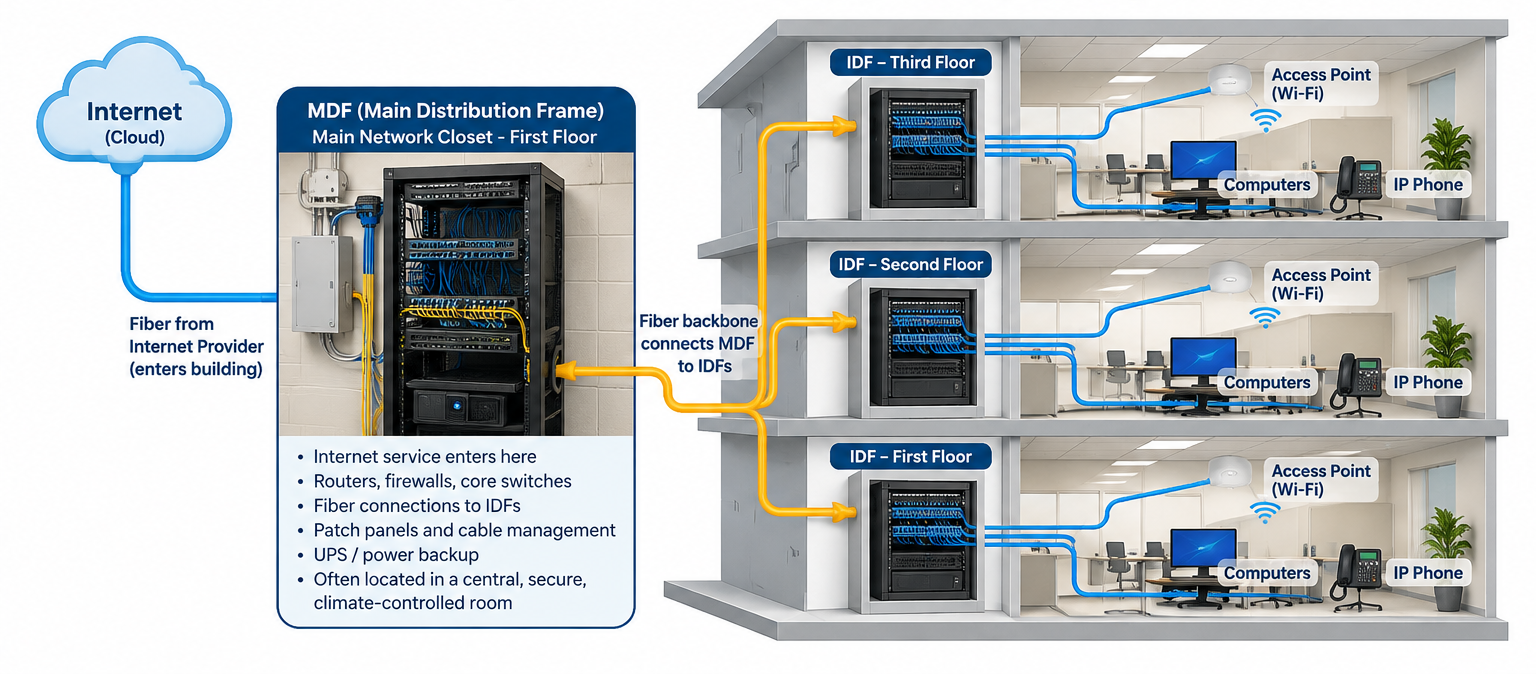
The MDF (Main Distribution Frame) is the primary network distribution location in a building. It's typically where the main internet connection enters the network and where core equipment such as routers, firewalls, core network switches, and fiber connections are located.
An IDF (Intermediate Distribution Frame) is a secondary network closet that serves another floor or section of a building. IDFs are typically connected back to the MDF using high-speed fiber optic cabling. Each IDF generally contains its own network switches to serve devices in that area. Computers, phones, wireless access points, security cameras, and other network devices connect to switches in the MDF or their designated IDF.
Smaller offices may need only one network room, while larger buildings may require multiple IDFs to accommodate cable distance limitations and provide reliable connectivity throughout the facility.
In larger commercial and industrial environments, IDFs may even be located in separate buildings. For example, if your property includes a warehouse, garage, or secondary building, that building may not need its own internet service. Instead, it can have an IDF connected by fiber optic cabling back to the main building's MDF, allowing the buildings to share the same network infrastructure and internet connection.
Proper MDF and IDF planning helps create an organized, scalable network that's easier to maintain, troubleshoot, and expand as your business grows.
How do you design a Wi-Fi layout to ensure full coverage across our new footprint?
Reliable commercial Wi-Fi requires much more than mounting a few wireless access points around a building. Unfortunately, we've encountered many installations performed by IT companies and electrical contractors where access point locations were simply guessed at, with little or no consideration given to building materials, interference, device density, or wireless coverage requirements. In many cases, the access point brand and model were selected without any documented technical justification. And when the installation doesn't perform as expected, the solution is often to simply add more access points. "More is better, right?" Not necessarily. Adding access points without proper wireless planning can actually make the problem worse by increasing interference, creating overlapping coverage, and introducing additional channel contention.
Charlotte Data Solutions does not design wireless networks through guesswork. We begin with a wireless site survey to evaluate the existing environment, identify potential sources of interference, examine current wireless networks, and understand how the space will be used. We also consider the number of users, types of devices, and performance requirements of the business.
Using this information, we select the appropriate wireless access point manufacturer and model, then use predictive wireless design software to model coverage and determine suitable access point locations. Our design considers signal strength, interference, channel planning, user density, network capacity, and the building's physical characteristics.For new construction, where an on-site survey of the completed space may not yet be possible, we can begin with predictive modeling using construction drawings and building materials. Once the installation is complete, we can perform on-site wireless testing to verify coverage and identify any adjustments needed to optimize performance
.We've been called in to troubleshoot and correct wireless installations where this planning was never performed. Poor access point placement, inappropriate equipment selection, and inadequate coverage planning can lead to dropped connections, slow performance, and frustrated employees.
Our approach is simple: Every access point should have a reason for being where it is, and every equipment selection should be supported by the requirements of the environment. We believe commercial wireless networks should be engineered, not guessed at.
Learn More: How Charlotte Data Solutions Performs a Wireless Site Survey →
What Network Infrastructure Does A New Office Need?
That depends on how your business operates, but most modern offices need considerably more than an internet connection and a consumer-grade wireless router.
We've encountered businesses running their entire office network from the Wi-Fi built into their cable company's modem or from inexpensive consumer routers intended for home use. While these devices may work adequately in a residential environment, they often lack the security controls, management capabilities, reliability, and capacity needed for a commercial network. With growing cybersecurity concerns surrounding consumer networking equipment, choosing the right hardware and keeping it properly secured and updated is more important than ever.A properly designed commercial network typically includes a business-class firewall or router, managed network switches, Cat6 or Cat6A structured cabling, commercial wireless access points, patch panels, and battery backup systems. Depending on the business, conference room AV equipment, VoIP phones, security cameras, access control systems, and fiber optic connections may also be required.
Network equipment should also be properly housed and organized. In smaller offices, a wall-mounted swing-out network rack or cabinet may provide sufficient space for patch panels, switches, and other equipment. Larger installations typically require dedicated floor-standing network racks or enclosed cabinets, with appropriate power, ventilation, cable management, and room for future expansion.
Charlotte Data Solutions evaluates your office layout, number of employees, equipment requirements, security needs, and expected growth to design an infrastructure appropriate for your business.
Our goal isn't simply to get your computers connected to the internet. It's to build a secure, reliable, organized network infrastructure that supports your business today and can grow with you tomorrow.
Can you handle the network installation even if we already have an IT company?
Absolutely. In fact, for over 26 years, IT managers, managed service providers (MSPs), and internal IT departments have been among our primary customers and business partners. Charlotte Data Solutions has routinely worked alongside IT professionals to provide the physical network infrastructure their businesses and clients depend on.
Many IT companies specialize in computers, servers, cybersecurity, software, and day-to-day technical support but don't have the equipment, personnel, or experience needed to handle larger structured cabling and commercial network infrastructure projects. That's where Charlotte Data Solutions comes in.We understand both the physical infrastructure and the technology that operates on it. We can install network cabling, fiber optic connections, network racks, patch panels, switches, and wireless access points while coordinating directly with your existing IT team.
We can also work with your IT provider to determine equipment requirements, network closet layouts, switch configurations, wireless network requirements, and connections for servers, phones, security systems, and other business equipment.
Charlotte Data Solutions can take responsibility for the physical network installation while your existing IT provider continues managing your network and supporting your employees. We understand the importance of clearly defined responsibilities, communication, and working together toward a successful installation.
Our goal isn't to replace an IT relationship that's already working well. We value our long-standing relationships with IT professionals and are here to provide the specialized network infrastructure expertise needed to complete your office build-out properly.
Charlotte Data Solutions — Bridging the Gap Between IT and the Office Build-Out.
Do you provide network cabling and office build-out services outside Charlotte
Absolutely. While Charlotte Data Solutions is based in Charlotte, North Carolina, our regular service area extends well beyond the Charlotte metro area. We routinely provide commercial structured cabling, network infrastructure, and office build-out services throughout the region, from Asheville to Greenville, South Carolina, and from Winston-Salem to Fort Mill.
Our work includes office relocations, structured cabling installations, network room build-outs, fiber optic cabling, commercial Wi-Fi installations, and network infrastructure upgrades.
We also travel beyond our regular service area for projects of all sizes. Depending on the location and scope of work, additional travel expenses may apply. We're happy to discuss your project and provide an estimate that accounts for the work involved and any necessary travel.
Whether you're relocating an office, opening a new facility, or upgrading an existing network, we're happy to discuss how we can help.
Sometimes, you just need the Charlotte Data Solutions experience on your project!
Why hire a structured cabling contractor instead of having our electrician install the network wiring during our office buildout or renovation?
Electricians are an essential part of any commercial construction project, and many electrical contractors also install low-voltage cabling. However, installing network cable and designing a reliable commercial network infrastructure are two very different things.
Charlotte Data Solutions brings over 26 years of experience in IT, networking, and structured cabling. We understand not only how to install the cables, but also what connects to them, how network equipment communicates, and how the entire infrastructure needs to function once your employees move in.
We've encountered installations where cables were pulled without adequate consideration for network performance, equipment requirements, wireless coverage, cable testing, or future expansion. The cabling may look fine when construction is complete, but problems often don't become apparent until the network is put into service.Our experience also extends beyond IT. With team members who have worked as general contractors in commercial construction, we understand building drawings, specifications, submittals, construction schedules, and coordination with other trades. We can work directly alongside your electrical contractor and general contractor to make sure the network infrastructure is properly incorporated into the overall project.
We're not simply installing wires between two locations. We're planning network rooms, designing cable pathways, selecting appropriate cabling, organizing racks and patch panels, testing connections, and making sure the infrastructure supports the equipment and applications your business depends on.
Electricians are experts in the electrical systems that power your building, just as Charlotte Data Solutions specializes in the network infrastructure that keeps your business connected. Both trades have their own expertise, and both are important to a successful office build-out.
After all, you wouldn't call Charlotte Data Solutions to rewire all the lights in your building. So why would you rely on your electrical contractor to design and build your company's network?
Charlotte Data Solutions — Bridging the Gap Between IT and the Office Build-Out.